Piotr Wiewior Establishes Strategic Initiative Colloquium at the NNSS
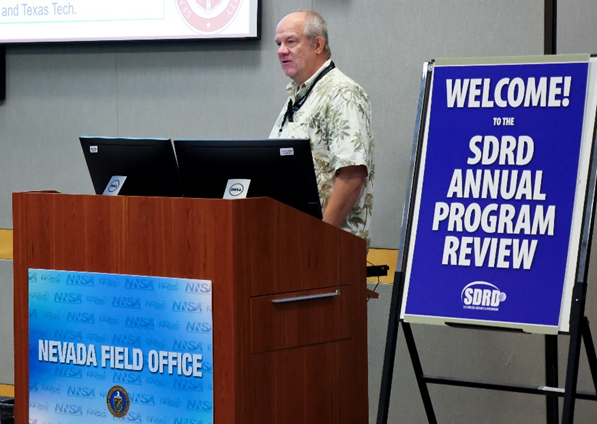
The Nevada National Security Sites’ (NNSS’) Site-Directed Research and Development (SDRD) program is instrumental in performing high-risk, potentially high-value experiments to enrich national security science. While each principal investigator (PI) is involved in producing knowledge in their subject areas, learning from community partners can often lead to fresh approaches and enhanced collaboration. In the spirit of scientific advancement, SDRD PI Dr. Piotr Wiewior has organized the Strategic Initiative Colloquium, a monthly series of scientific talks given by NNSS collaborators, to support SDRD’s Strategic Initiative in Accelerator Science and Beam Physics.
The aim of the Strategic Initiative is to develop the skills of current and future NNSS scientists and engineers with the goal of facilitating a modern experimental and theoretical program in-house. When he first took on the PI role for the Strategic Initiative, Piotr saw an opportunity to draw from his experiences in academia to complement these goals through the implementation of a colloquium, or talk series. Colloquiums are a standard practice at most universities, and he realized that the NNSS personnel working on the Strategic Initiative might benefit from a similar collaborative and educational venue: “The whole idea was to bring in external experts from their fields to share insights, spark new ideas, help people network, and even kickstart collaborations,” Piotr says.
Piotr began reaching out to his university and professional contacts and officially started the Strategic Initiative Colloquium in December 2024 with a keynote presentation by Juan Barraza, Chief Engineer for Advanced Sources and Detectors at Los Alamos National Laboratory (LANL). His talk provided a comprehensive overview of the Scorpius accelerator technology. Since then, the Colloquium has presented many talks on topics relevant to NNSS scientists. Dr. Aaron Covington from the Physics Department at the University of Nevada, Reno (UNR) presented the second talk, which was an overview of recent pulsed radiation source development at UNR. In May 2025, the Colloquium hosted Dr. Ray Allen from the Naval Research Laboratory, who discussed his innovative CASTLE Circuit Simulator and its direct application to the Scorpius accelerator. Also in May, during the 2025 Prompt Radiation Detection and Imaging Workshop, the Colloquium invited speaker Dr. Stephen Andrews from LANL to deliver a talk on modeling multi-pulse targets.
Most recently, Dr. Jacob Stephens, an associate professor at Texas Tech University, presented on the topic of solid-state pulsed power for ultra-compact nonlinear transmission lines in June. This was followed by a talk in July by Dr. Brendan Tran Morris, a professor at the University of Nevada, Las Vegas, about computer vision and machine learning. In August, Dr. Benjamin King from UNR’s Chemistry Department spoke about his research on polymer and materials chemistry. All three talks were widely attended both in-person and online by employees from across the NNSS.
After such a successful start in FY 2025, Piotr has already started curating talks for FY 2026. In October, two speakers will be featured in the Colloquium. Dr. David Wetz from the University of Texas at Arlington will speak on Oct. 7 about his research on pulsed power, power systems, electrochemical energy storage, and pulsed dielectric breakdown. On Oct. 29, the Colloquium will officially become “international” with a presentation from Mark Sinclair, who works on pulsed power at the Atomic Weapon Establishment in the United Kingdom and is part of the team working to commission the Merlin IVA at the Epure facility in France. By introducing NNSS scientists to the work being done across the globe, Piotr hopes to make the Enhanced Capabilities for Subcritical Experiments team feel more connected and informed: “It’s been a real boost, bringing in outside thinking and showcasing that there’s a wider community doing this work.”
Congratulations to Piotr on a successful first year of running the Strategic Initiative Colloquium, and we look forward to attending more informative presentations in the coming fiscal year!