Carson Schuetze Revitalizes Nuclear Search with Machine Learning
As artificial intelligence has become more common within scientific research, Site-Directed Research and Development (SDRD) PI Carson Schuetze recognized an opportunity to improve the efficiency of the nuclear search mission at the Nevada National Security Sites (NNSS). The mission needs include increased threat detection probability without increasing the false alarm rate, increased analyst sensor throughput, anomaly prioritization, and optimized sensor time on-target. Carson realized that these could all be addressed with the use of machine learning (ML), an idea she began exploring in her fiscal year (FY) 2025 SDRD project.
Carson’s approach is to implement a cloud-based architecture that can enable adaptive learning and statistical meta-analysis to be performed on aggregated data from all systems, sensors, and algorithms across space and time. Because the project requires a dense, highly curated historical archive, she can use ML algorithms to identify equipment abnormalities, optimize parameters for meta-analysis, and continuously adapt. She foresees that using ML algorithms in this way will help to pave a path for cloud implementation at the mission level.
In the first year of her project, Carson and her team took a unique approach to developing their methods: they created a simulated dataset based on data from Super Bowl 58 to test the various ML methodologies they identified during their literature review. From this Super Bowl data, the team developed a document for nuisance rejection spectral comparison ratio anomaly detection (NSCRAD) that they can utilize for the duration of the project. In testing their methods against NSCRAD, Carson and her team found that their best model improved detectability in simulated data by over 256%. This means that even highly shielded or very small sources can be detected without increasing the false alarm rate.
In addition to working with the Super Bowl data, Carson identified an overlap between her SDRD project and the work conducted in an FY23 project by PI Chris Burt. Chris used the North Virginia Array to show the efficacy of using convolutional neural networks (CNNs) to classify radioactive sources. Carson and her team believe that such an approach can be modified for use in their SDRD project. They have already tested the CNN on one simulated and one real dataset, and plan to continue further testing in FY26. By building on a previous SDRD project in this way, Carson and her team can ensure the longevity of technologies and ideas that originated in the SDRD program.
While Carson’s project has made exciting strides for the nuclear search mission, it has also been instrumental in connecting scientists across work locations. Prior to her project, she observed that the nuclear search scientists at the Remote Sensing Laboratory – Nellis and the data scientists in North Las Vegas possessed complementary skillsets and interests. However, because of their separate work locations, collaboration was not occurring. Through Carson’s project, though, scientists at both locations were able to connect and produce more meaningful work through the combination of their unique skills. Now, Carson and her team can answer radiological questions from multiple points of view and gain more useful information for future work.
In FY26, Carson and her team plan to further utilize ML to improve their methods. Currently, her meta-analysis method can only be used to analyze data in post-processing, so her aim is to modify them to work in real time. Such a modification would allow the method to alarm during surveys and events, similar to existing anomaly detection algorithms, and would ensure its use in mission operations. She also plans to incorporate time-based clustering alongside the spatially correlated clusters that the method already uses, which will allow the team to use historical data and previous passes from the same location as context for alarming. Finally, Carson and her team are working to implement the method into the AVID simulator so that they can perform field testing. The team’s goal is to curate the AVID data they collect by using a common format, which would enable them to experiment with even more advanced ML models.
As Carson and her team continue to improve the NNSS nuclear search mission with meta-analysis methods and machine learning, we wish them success!
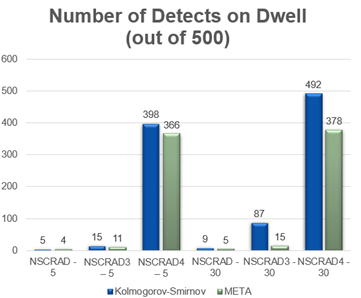
Figure 1. Experiment results show improvement over existing methods.
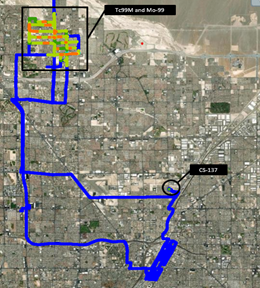
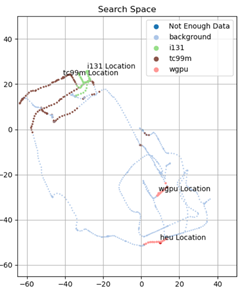
Figure 2. CNN results over simulated (left) and real data (right).