
SDRD Highlight: Scientist Cliff Watkins Using New Technologies To More Quickly Address Old Problems
SDRD Embraces AI and ML to Advance the NNSS Mission
Michael Mortenson, a data scientist involved in three SDRD projects, witnesses firsthand the breadth of AI and ML research being done in the program. “There are one or two projects that involve LLMs, another project that is de-blurring images with deep learning, and one that uses ML for object detection and classification,” he says.
Of SDRD’s AI and ML portfolio, one of the most exciting projects currently underway is “Background Subtraction and Noise Reduction via Machine Learning,” which is led by PI Cliff Watkins. Cliff’s aim with this project is to explore methods for interpreting data coming into SDRD using ML. Specifically, his goal is to perform high quality signal extractions by using a neural network to subtract background and noise from data, which would be applicable to radiography, interferometry, hyper-spectral data, and gamma spectroscopy.
From his research so far, he sees more value for ML as a tool to meet certain requirements in the research process, not as a blanket solution for all scientific problems. “When you run scientific experiments, you are trying to find a story to tell for making certain decisions, not to solve every problem in the universe. ML helps to more efficiently identify specific trends in data so we can tell those stories earlier,” Cliff explains.
Part of that storytelling effort is learning how to best integrate ML methods with human users’ workflows. Cliff describes his approach as building an ML toolkit instead of replacing human workers. “The most helpful strategy is to develop ML concurrently with our processes. ML can help to speed up the iterative work of the scientific process, especially on data that a team hasn’t spent a lot of time on. But we still need people to interpret the results to tell a story and make good decisions.” From the insights Cliff has gained through this project, the SDRD program can focus on strategic deployment of quality ML approaches rather than inefficiently applying ML to large quantities of data.
Michael, who has contributed work to Cliff’s SDRD, agrees that the next step in AI and ML research involves specializing the tools to the NNSS’ purposes: “Across science and engineering, everyone is trying to figure out AI and ML, but no one has fully solved the problem. For that to happen, we need to get good at the tools that are already out there by helping people foster the skills to do the work and developing access to code and weights. That’s where the SDRD program is right now.”
To that end, Michael started an informal monthly learning group for data scientists called “Byte-sized Learning” to gather and share the knowledge and skills they’ve gained through various projects. He has also been working with Information Technology to develop good workflows to help employees get approved to use new AI and ML tools. By instituting these processes, Michael and other SDRD data scientists are helping to lay the foundation needed for researchers to begin specializing AI and ML tools to the NNSS’ national security mission.
As SDRD works toward achieving improved specialization, the program continues to sponsor boundary-pushing research, most recently with the FY27 proposal call. The Science and Technology Thrust Area (STTA) of Technology and Research in Artificial Intelligence for Nuclear Security (TRAINS) was established last fiscal year to encourage more work involving AI and ML. This proposal cycle, many white papers have already been submitted that intersect with TRAINS and aim to improve AI and ML tools for use in other research areas. The next fiscal year will undoubtedly see further progress made by PIs toward honing AI and ML technologies for use at the NNSS.
Because the SDRD program supports high-risk, potentially high value projects, it is the ideal venue for exploring emerging technologies like AI and ML. With the cutting-edge work being done by the PIs, the NNSS is better equipped to use AI and ML in meaningful ways to support the national security mission.
Good luck to the SDRD PIs as they continue to explore the potential of AI and ML technologies!
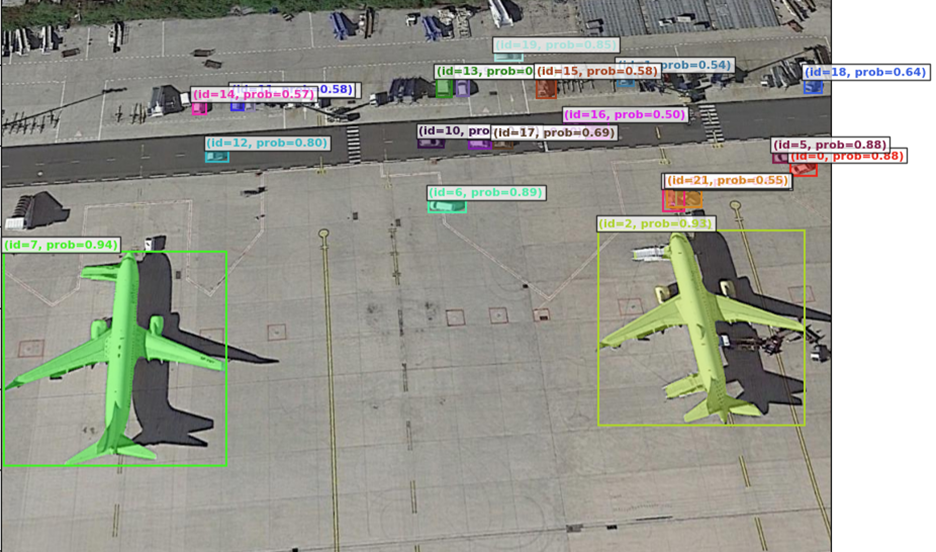
Figure 1. Object detection work completed by Michael Mortenson for Cliff Watkins’ SDRD project in FY26 using Meta’s open-source foundation model SAM3.