National Security Science Shines at the SDRD Annual Program Review
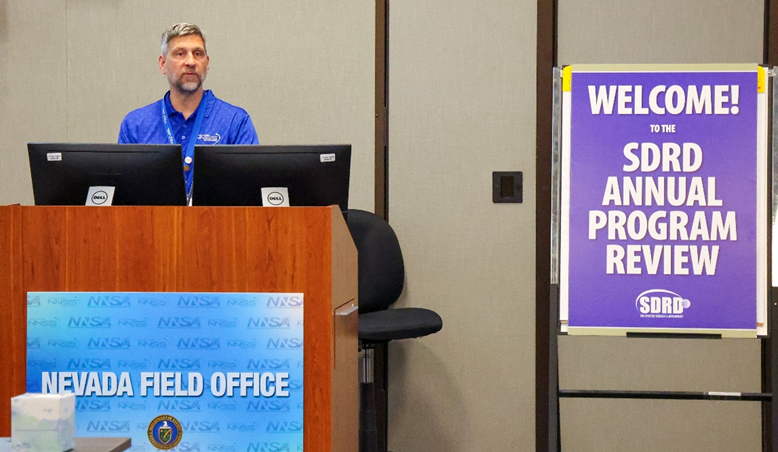
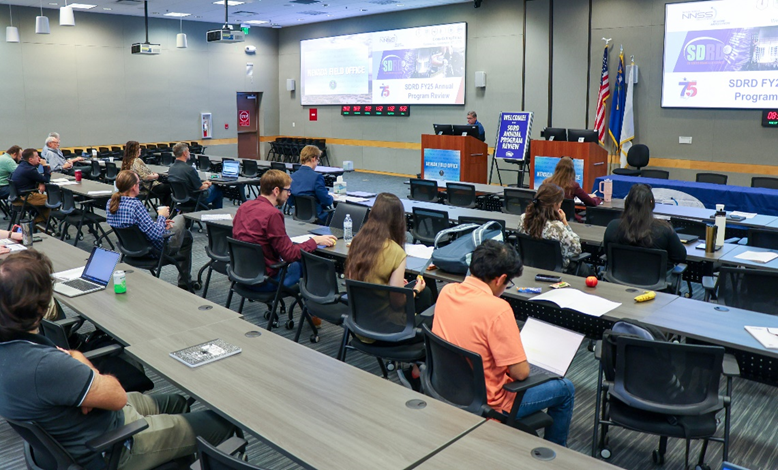
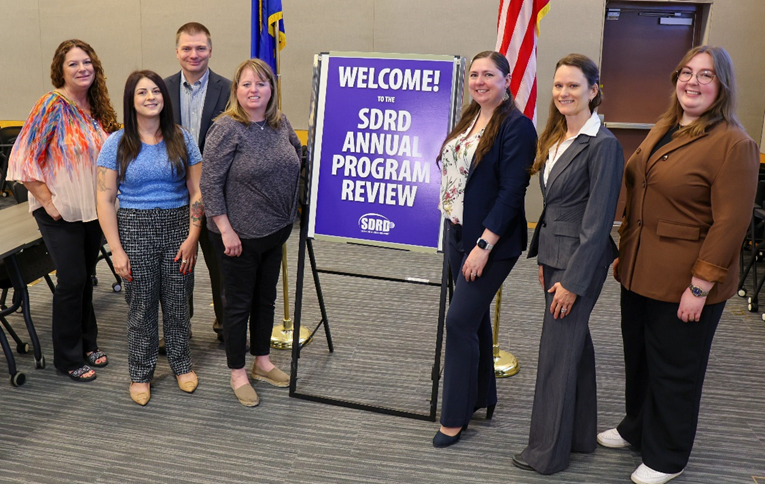
At the end of each fiscal year, the Site-Directed Research and Development (SDRD) program hosts its Annual Program Review (APR) showcasing the high-risk, high-value research conducted by its principal investigators (PIs). Taking place Sept. 9–11 at the North Las Vegas facility (NLVF), this year’s APR was attended by employees from across the NNSS’ locations, as well members of the External Advisory Board (EAB) and the National Nuclear Security Administration Nevada Field Office.
This past year, the SDRD Program worked with program leadership to redefine the Science and Technology Thrust Areas (STTAs) to better align with the NNSS mission areas. To that end, the APR was sectioned by STTA: Global Security mission space, Stockpile Science mission space, and one cross-cutting STTA straddling both. Directors and leaders from across the NNSS complex including Alexis Reed, Daniel Lowe, Michele Baker, and José Sinibaldi opened these different sections and shared their thoughts on how SDRD projects and PIs directly contribute to our NNSS missions.
The first day of the APR highlighted projects under the Global Security mission area and included projects from the STTAs Radiography and Analysis for Photonic Imaging Detectors Systems (RAPIDS), Emergency Response Operations Sensors and Systems (EROSS), and User-Centered Remote Testing and Operations (UCRTO). Projects from the first day included updates on the NNSS’ first Interlaboratory Lab-Directed Research and Development project, “Portable High-Resolution MeV Neutron and Radiography” (PI Charles Leak, RAPIDS), “Development of Assessment Methodology for Fielded Radiation Detector Crystal Characterizations (PI Joshua McCumber, EROSS), and “Fundamental Experiments for Detonation Signature Modeling” (PI Clare Kimblin, UCRTO).
Day two featured projects from the cross-cutting STTA Technology and Research in Artificial Intelligence for Nuclear Science (TRAINS) with projects such as “Cloud-Based Meta-Analysis with Adaptive Learning for Massive Sensor Networks” (PI Carson Schuetze), and smaller, shorter projects known as Feasibility Studies from across all the STTAs. The SDRD Program Management Office presented the fiscal year 2024 Most Valuable PI award to Robert Buckles for his work and mentorship on the project “Ultrafast High-Dynamic-Range Photomultiplier Trials.” In addition to presentations, attendees participated in a tour of the Integrated Test Stand and C3 launcher showcasing specialized capabilities housed in North Las Vegas.
The final day of the APR was dedicated to projects under the Stockpile mission area. PIs from the STTAs Advanced Radiation Sources (ARSO), Dynamic Experiment Diagnostics (DED), and RAPIDS presented under this category, including the “Strategic Initiative: Developing the NNSS Critical Skills in Accelerator Science and Beam Physics” (PI Piotr Wiewior, ARSO), “Ensuring Diagnostic Readiness for Subcritical Experiments: Redesigning the Detonator Probe” (PI Patrick Younk, DED), and “Study of Intense Electron Beam Target Interaction for Radiographic Applications” (PI Todd Haines, RAPIDS).
Beyond giving PIs the opportunity to present their work to the SDRD program and programmatic stakeholders, the APR also helps to promote collaboration among the NNSS’ different sites. Attendees from across the country were able to network and exchange ideas with each other during the breaks and social events. With a better understanding of the expertise and capabilities of each site and their personnel, PIs are better primed to conduct meaningful and useful research through the SDRD program in service of the NNSS’ national security goals. Furthermore, the APR was instrumental in strengthening the relationships between the PIs, SDRD Program Management, programmatic leaders, and EAB.
Congratulations to the SDRD PIs on another great fiscal year of research and another successful APR. We look forward to the exciting research and collaborations that will emerge from the connections made during this year’s APR and we will see you all next September!