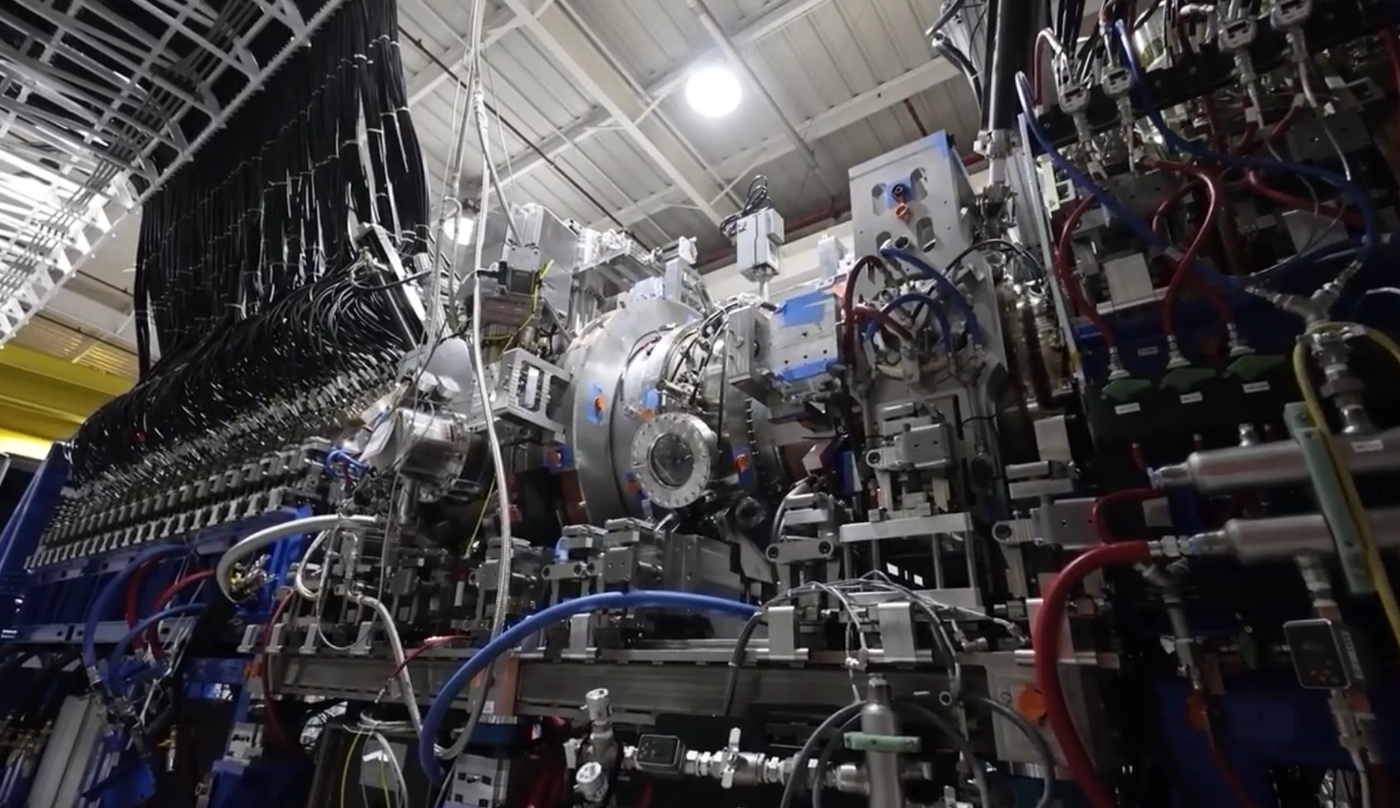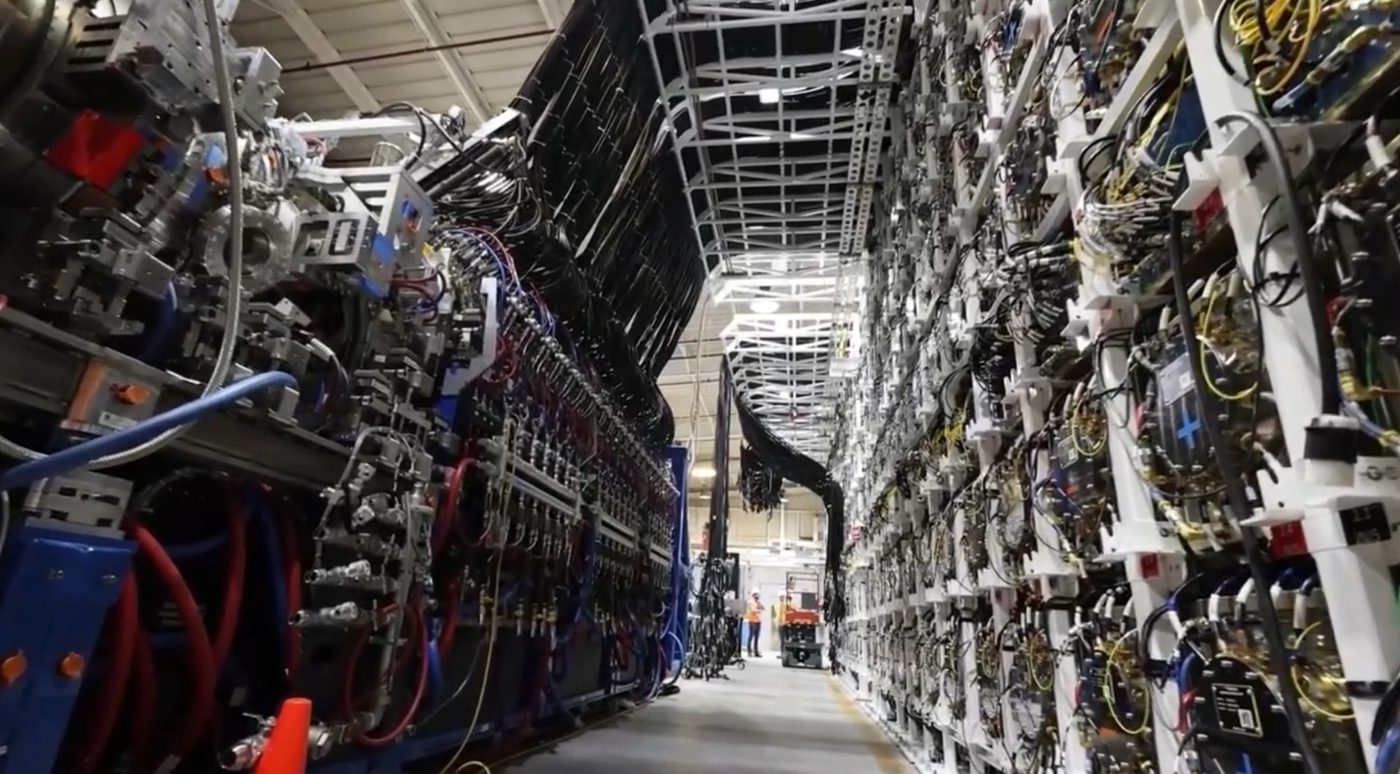
More than a decade of cutting-edge design and engineering came to life in October as scientists and engineers began integrated live testing on the next-generation Scorpius linear induction accelerator.
Taking place inside the Integrated Test Stand (ITS) at the Nevada National Security Sites’ (NNSS) North Las Vegas campus, the milestone marks the first time major hardware components developed across the National Nuclear Security Administration’s (NNSA) Nuclear Security Enterprise have been connected, powered up, and operated as one cohesive machine.
Scorpius is a roughly 100-meter-long, state-of-the-art accelerator being built to capture high-speed, multi-frame radiographic images of subcritical experiments. Data gathered from these images will validate the sophisticated supercomputer models used to annually certify the nation’s nuclear deterrent, directly contributing to the safety and security of the United States and its allies. Once complete, Scorpius will be installed nearly 1,000 feet underground at the NNSS’ Principal Underground Laboratory for Subcritical Experimentation (PULSE). But before the full machine is lowered into the earth, the team is using the ITS facility—which broke ground in July 2023—as an essential aboveground test bed.
This initial test series focused on overcoming a signficant hurdle: delivering high-voltage pulsed electrical power into the machine’s injector without generating an electron beam.
“At Sandia, we designed and built the injector and tested it at the component level,” said Marc Mitchell, injector technical lead at Sandia National Laboratories. “The Integrated Test Stand is our first opportunity to assemble the full injector and test it alongside the pulsed-power drivers. We are ramping up slowly and deliberately to get the voltages and timings exact, ensuring the foundation is solid before we create a beam down the road.”
To drive that energy, Lawrence Livermore National Laboratory engineered specialized solid-state pulsed-power units called Line Replaceable Units—modular boxes that slide in and out for easy maintenance.
“This was our first time powering the injector with the pulsed-power system in this configuration,” said Jennifer Ellsworth, solid-state pulsed-power technical lead at Lawrence Livermore National Laboratory. “Even without generating a beam, this allows us to exercise the entire machine: the high-voltage power, the control and cooling systems, diagnostics, and calibrations. We started this over 10 years ago with just a vision and some concepts. To have participated in those early discussions and now see the hardware here and operational is very exciting.”
The rigorous 13-week testing schedule also gives operators their first opportunity to run the central control room with an integrated, multi-laboratory crew.
“Everyone has already tested their subcomponents at their home labs, but this is the first time we’ve tested everything as a cohesive unit,” said Michael Misch, ITS technical lead and deputy chief engineer for Scorpius at the NNSS. “Building and testing a machine of this scale has never been done before. The test stand gives us the room to learn lessons, refine workflows, and correct issues here on the surface before everything heads underground to PULSE, where the final accelerator will be five times larger [than ITS].”
These baseline electrical trials establish critical operating boundaries to protect the delicate machinery before beam generation testing begins in spring 2027.
“The hardware comes together first, and with it, all the software and control infrastructure our teams spent years developing,” said Chris Silbernagel, NNSS integration and commissioning manager for Scorpius. “Watching this multi-site team grow over the years and now sit side-by-side in the control room to see real signals show up exactly when and where they’re supposed to—that is what makes this milestone so meaningful.”
For more information on the Scorpius project and the NNSS’ role in national security science, visit NNSS.gov or check out this YouTube video on PULSE and the Scorpius accelerator.